You want to build a cat enclosure — a catio — that your cat will never want to leave. No long introduction on why a catio is a good idea — you already know that. Instead, you'll get exactly what you need here: where to start, how to secure it, and most importantly — how to furnish it so your cat uses its enclosure daily until the last ray of light. And makes your neighbors envious.
Step 1: Choosing the Right Location for Your Cat Enclosure
The location dictates everything — usage, safety, and how much joy your cat truly gets from its cat enclosure. Three factors are crucial:
Direct Access from Inside
The most important criterion: Your cat should be able to enter and exit its cat enclosure independently at any time — without you having to open the door every time. This means the enclosure must directly adjoin a living space, ideally via a cat flap in the patio door, an exterior wall, or a window.
The best solution is a cat flap in the patio door or sliding door. Alternatively, a flap directly through the wall works — more complex, but the most elegant option. Important: The flap should only open for your cat — a chip-controlled flap is definitely worthwhile here to prevent stray animals from entering.
Planning Sunny and Shady Zones
Cats switch between sun and shade all day — they warm up and then seek coolness again. A cat enclosure that consists only of sun or only of shade will not be optimally utilized. Plan at least one fully shaded zone from the beginning — either through its natural location, a sunshade sail, or a covered corner. In summer, this is not a comfort feature, but a health issue.
Size: As Large as Possible, as Small as Necessary
For a functional cat enclosure, an area of just 2 × 2 meters is sufficient — if the vertical space is optimally utilized. A small footprint with high climbing opportunities is always better than a large flat area without structure. For a patio or balcony: even 4–6 m² are perfectly adequate if the enclosure is well furnished. More on this in the furnishing section.
Step 2: Properly Securing Your Cat Enclosure
Without proper security, a cat enclosure is not an enclosure — it's a trap. Cats are exceptionally skilled climbers and jumpers. A 1.80 m high wall is no obstacle for most cats. Security must be well thought out from the start.
The Cat Net — The Most Reliable Solution
A fine-mesh cat net is the most proven and flexible method for securing a cat enclosure. It is almost invisible, allows air and light to pass through, can be shaped into any form, and safely keeps even active climbers contained. Pay attention to the following points:
Mesh size maximum 5 × 5 cm — larger meshes can be squeezed through by cats, especially small or slender animals.
Material: Polypropylene or stainless steel — Polypropylene is inexpensive, lightweight, and sufficiently weather-resistant for most catios. Stainless steel nets are more durable, more expensive, and the better choice for year-round outdoor use.
Don't forget the roof — an open cat enclosure is not a safe cat enclosure. Cats jump upwards just as well as forwards. Without roof security, the enclosure is open at the top — and therefore unsafe.
Wooden Frame or Metal Construction
The frame to which the net is attached determines the stability of the entire cat enclosure. For smaller catios on patios or balconies, a sturdy wooden frame made of pressure-treated wood is sufficient. For larger constructions in the garden, galvanized steel posts are recommended — more weather-resistant and durable.
Important rule of thumb: All connections and attachment points must be designed to withstand three times the cat's weight — cats land with full force and climb with considerable strength.
Anti-Climb Protection at the Top
If you don't want to build a complete roof, there's a proven alternative: an inwardly sloping overhang at the top of the fence wall — similar to outdoor enclosures for other animals. An inwardly angled attachment of 30–40 cm makes it impossible for cats to climb over the top edge. Ideal for large garden enclosures where a complete net roof would be impractical.
Don't Forget Ground Security
Cats that want to escape sometimes dig. Bury the net at the ground level at least 30 cm deep, or lay it horizontally on the ground and cover it with soil or mulch. This way, the path downwards is also blocked.
Step 3: The Floor of the Cat Enclosure
The floor has more influence on the use of the enclosure than most owners think. Cats love natural surfaces — they stimulate the senses, challenge their paws, and provide variety.
Bark mulch is the most popular choice — soft, naturally smelling, cushions the impact when landing, and is easy to refresh. Look for pollutant-free quality without chemical additives.
Grass or soil gives your cat a real outdoor feeling — it can dig, sniff, and eat grass. More maintenance-intensive, but the maximum experience for the cat.
Stone slabs or wooden decking are suitable as a partial area — ideal as warm sunny spots that heat up and serve as cozy lounging areas. Combine different floor coverings for maximum variety within the cat enclosure.
Step 4: Furnishing — This is Where Your Cat Enclosure Becomes Great

The construction is the foundation. The furnishing is the experience. And here lies the biggest difference between an average cat enclosure and one that your cat uses daily until dusk.
The secret: Think vertically. A cat run that is only used at ground level utilizes 20% of its potential. The real magic happens at height — with climbing opportunities, vantage points, and retreats on different levels.
The Cat Wall — The Heart of Every Good Cat Enclosure
A wall-mounted cat climbing wall made of solid pine wood is even more attractive in a cat enclosure than indoors — because outdoors, fresh air, sounds, and smells are added, making climbing a real adventure.
On one wall of the enclosure, ideally the south-facing wall, you mount the climbing structure — from ground level to almost the roof. Your cat can overlook the entire cat run from above, watch birds, enjoy the fresh air, and still quickly get down — and inside — at any time.
All Sweetypaws elements are made of solid pine wood and are suitable for outdoor use — the natural material tolerates moisture well and becomes more beautiful, not worse, over time. Optionally, you can treat the elements with a cat-safe wood oil to extend their lifespan.
Stairs and Climbing Steps — For Maximum Height
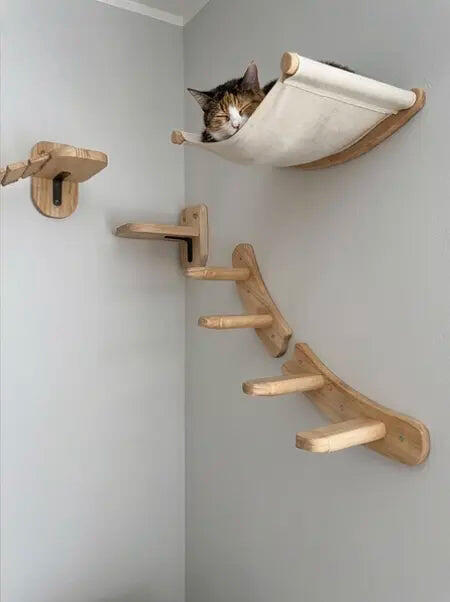
The fastest way up in the cat enclosure are wall-mounted stairs and climbing steps. Outdoors, they are particularly practical because they are robust, do not take up floor space, and blend seamlessly into the overall structure of the enclosure.
Plan the stairs so that they lead from a ground-level entry point to a viewing shelf at 160–180 cm. From there, your cat has the best view over the entire cat run and the surrounding area — bird watching included.
Ropes and Scratching Elements — Pure Outdoor Fun
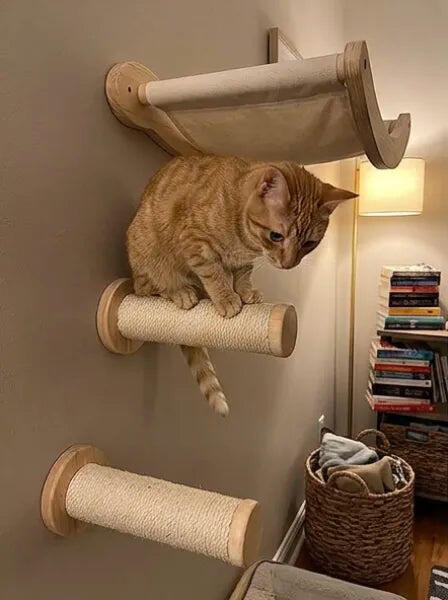
Outdoors, cats' scratching needs are even more pronounced — they mark their territory more intensely outside than indoors. A sisal knot rope in the cat enclosure is therefore not an optional extra, but a must.
The rope hangs vertically on the wall, the cat scratches, climbs, plays — and your enclosure is both a playground and a territory for it. Sisal weathers particularly beautifully outdoors, by the way — the fibers roughen over time and become even more attractive to cats.
Hammocks — Every Cat's Favorite Spot
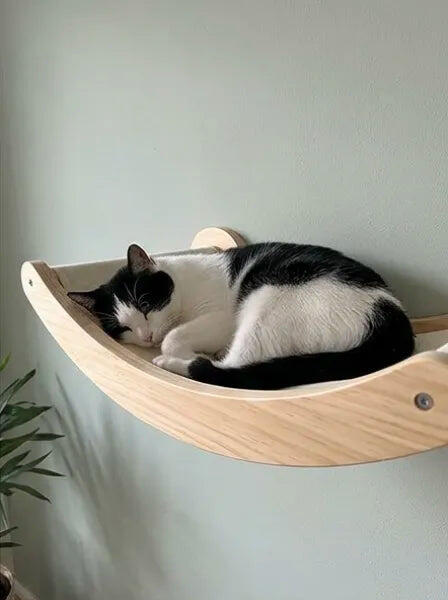
If you only integrate one element into your cat enclosure — then a wall-mounted hammock. Cats love the gentle swaying, the elevated position, and the ability to stretch out completely. Outdoors, with the wind in their whiskers and the sounds of nature — that's cat paradise.
Mount the hammock at a height of 100–150 cm, on a weather-protected wall. For maximum comfort: place it so that your cat can observe the outside world from there — a tree, the street, the birds in the sky.
Cat Bed and Cave — For Rain and Retreat
A good cat enclosure also has something to offer in bad weather. A wall-mounted cat house in a covered corner of the enclosure is the perfect shelter — whether during light rain, strong sun, or if the cat simply wants to be undisturbed.
Mount it at 120–150 cm height with a view of the main area of the cat run. This way, your cat can observe from inside without being seen itself.
Wall-Mounted Feeding Station — Practical and Hygienic
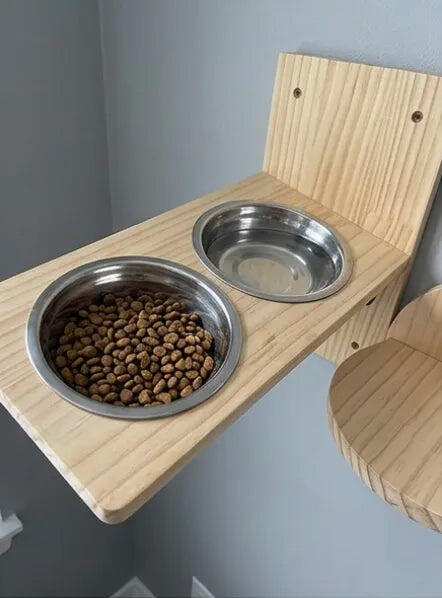
A wall-mounted feeding station in the cat enclosure keeps insects and other animals away from the food — and gives your cat the feeling of eating its food in an elevated position, as its predatory instinct demands.
Mount the station at 60–80 cm height in a weather-protected corner. Always provide fresh water — cats drink significantly more outdoors than indoors.
Step 5: Planting — Cat-Safe and Beautiful

Plants turn a cat enclosure into a true nature experience. But be careful: many popular garden plants are toxic to cats. Stick to these safe options:
Catnip (Nepeta) — the absolute must-have for every cat run. Most cats react intensely to it and spend hours rolling and sniffing in it. Robust, winter-hardy, self-seeding.
Valerian — even more intense than catnip. A real highlight in the enclosure for cats.
Cat grass (Dactylis glomerata) — Cats chew grass for digestion and as a natural supplement. A pot of cat grass in the enclosure will be visited daily.
Lemon balm and thyme — aromatic, non-toxic, attractive to cats.
Absolutely taboo in the cat enclosure: lilies, ivy, cherry laurel, laburnum, oleander, and all bulb plants. These are highly toxic to cats — even small amounts can be life-threatening.
The Secret Trick: Design Your Cat Run For Yourself Too
The most beautiful cat enclosures we know have one thing in common: the owner enjoys sitting in them as much as the cat. And that's no coincidence — it's strategy.
A cat run built only for the cat often remains half-finished. No planting, no seating, no proper floor — because there's a lack of motivation to truly invest time and money. But as soon as you create a cozy corner for yourself in it, everything gets better: more beautiful, more thoughtful, more lovingly designed. And your cat benefits directly from it.
Place a comfortable garden chair or a small bench in the enclosure. Enjoy your morning coffee there — with your cat dozing beside you in her hammock, watching the birds. This is not only beautiful, it also strengthens the bond between you. Cats that regularly spend time with their owners in the same space are more relaxed and self-confident.
Design with plants that both of you like. Lavender smells wonderful and is non-toxic to cats. Herbs like thyme, rosemary, and sage look good, smell intensely, and are safe. Bamboo as a privacy screen gives the enclosure privacy and creates a calm, green atmosphere — for you and your cat.
Think about lighting for the evening hours. String lights or a small solar lamp transform the cat enclosure into a real outdoor space that you'll want to enjoy even after sunset. And as long as you're outside, your cat is too — this significantly extends the active time in the enclosure.
The most important catio rule is: If you don't like sitting there yourself, your cat won't either. Spaces that are well-maintained, lively, and lovingly furnished magically attract cats. Spaces that feel like storage are avoided.
Step 6: Weather Protection for Year-Round Use
A cat enclosure that becomes a sauna in summer and a shower in the rain will not be used. Plan for weather protection from the start:
Sun sail or roofing for at least one third of the ground area — this is the minimum requirement for safe use in summer. Cats can quickly overheat in the heat.
Water source always accessible — cats drink more outdoors. A small drinking fountain in the cat enclosure is ideal because flowing water attracts cats much more than standing water.
Retreat option in rain — the wall-mounted cat house or a covered corner ensures that your cat can stay outside even in light rain.
Do I Need a Building Permit for My Cat Enclosure?
This is one of the most common questions when building a cat enclosure — and the answer is: it depends. In Germany, building law is a matter for the federal states and varies from municipality to municipality.
As a rule of thumb: Small cat enclosures on patios and balconies up to about 10 m² of floor space are permit-free in most federal states. Larger constructions in the garden, especially those with a fixed foundation or permanent anchoring, may require a permit. In case of doubt, check with your local municipality — it's a 5-minute call and gives you legal certainty.
This is What the Perfect Cat Enclosure Looks Like
If you follow all the steps, you'll create a cat run that looks like this: a securely netted area with direct access from inside. On one wall, a complete climbing structure made of wood — stairs, shelves, hammock, and cat house at different heights. On the wall, a sisal knot rope for scratching and climbing. In the floor area, a mix of bark mulch, stone slabs, and a pot of catnip. In a protected corner, a wall-mounted feeding station and a drinking fountain. Above it all, a sun sail providing shade.
Your cat will use the cat enclosure from morning till evening. It will sleep there, climb, scratch, observe, and hunt — in safety, in freedom, near you.
Browse our individual elements or start directly with one of our ready-made sets as a basis for your enclosure climbing structure.
Frequently Asked Questions
What mesh size do I need for a safe cat enclosure?
Use nets with a mesh size of maximum 5 × 5 cm. For most catios, polypropylene net in 1.2–1.5 mm thickness is sufficient. For permanent outdoor use, stainless steel nets are recommended — more expensive, but maintenance-free and weather-resistant for many years.
Do Sweetypaws elements need special treatment for outdoor use in a cat enclosure?
Not necessarily — solid pine wood tolerates moisture well and weathers beautifully. For maximum longevity, we recommend treatment with a cat-safe wood oil or hard wax oil. Do not use solvent-based varnishes or stains — these are harmful to cats.
How big does a cat enclosure need to be at least?
For one cat, 2 × 2 meters are already sufficient — if the area is well utilized vertically. With a climbing structure that reaches up to 180 cm, you have effectively created several levels on 4 m². For two or more cats, we recommend at least 6–8 m² of floor space.
Can I build a cat enclosure on the balcony?
Yes — balconies are ideal for a cat enclosure. The railing serves as a natural base for net attachment. Important: The net must be completely closed, including at the top. On higher floors, a fall is enough to seriously injure a cat — even if cats almost always land on their feet.
Which plants are safe in a cat enclosure?
Safe and recommended: catnip, valerian, cat grass, lemon balm, and thyme. Absolutely avoid: lilies (all types — highly toxic), ivy, cherry laurel, laburnum, oleander, and all bulb plants. In case of doubt, you can find a complete list of toxic plants for cats on the website of the German Veterinary Medical Society.
Do I need a building permit for my cat enclosure?
In most cases not — small cat enclosures on patios and balconies up to about 10 m² are permit-free in most German federal states. Larger constructions in the garden may require a permit depending on the municipality. In case of doubt, check with your local municipality.